New paper co-authored by FORSAID partners examines woodwasp movement through global trade
A scientific article co-authored by FORSAID experts was recently released, examining how woodwasps have spread through global trade, drawing on more than 3,000 historical border interception records from the USA, Canada and New Zealand. The new output was listed in Volume 28 of the Biological Invasions Journal and includes consortium members Davide Nardi from the University of Padova (UNIPD) and Eckehard G. Brockerhoff from the Swiss Federal Institute for Forest, Snow and Landscape Research (WSL) among the team of authors. While the Siricidае group of species is not a primary focus for FORSAID, the findings speak directly to one of the project’s main objectives by highlighting the importance of improving approaches for early pest detection in pursuit of a stronger plant health standard across European forests.
More specifically, the paper attests that the vast majority of woodwasps were found to be hiding in wood packaging materials. In that sense, materials such as dunnage, crates and pallets were prevalent across most of the data, accounting for:
-
97.6% of USA interceptions recorded between 1914-1984
-
90.1% of Canadian interceptions recorded between 1997-2019
-
84.2% of New Zealand interceptions recorded between 1950-2007
Despite this steady intensification of woodwasps’ global movement, the findings reveal a clear mismatch. While substantial numbers of specimens get intercepted, few among them go on to establish communities outside their native range. As it turns out, in order for an invasion to be successful, key factors such as host tree availability and climate must be at play.
Building on this point, only 17.8% of intercepted woodwasps could be identified down to species level. Among those, Sirex juvencus stood out as the most commonly identified across all three countries, closely followed by Urocerus gigas and Sirex noctilio (as showcased in one of the paper’s figures below).
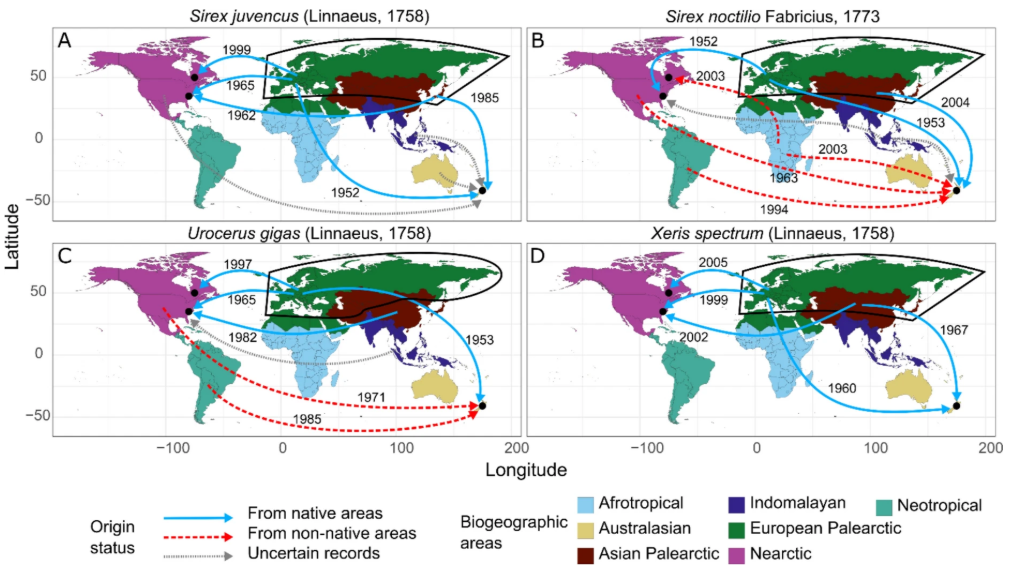
Overall, the study concludes that growing world trade raises the risk of new woodboring species reaching new regions, including Europe. In this context, border interception data proves itself a valuable tool for tracking purposes. Nevertheless, the authors also make it clear that accurate identification remains a core, albeit elusive, objective for biosecurity. According to the paper, over 90% of US interceptions and over 75% of Canadian interceptions were not identified to species level because the larvae are difficult to tell apart. In an attempt to bridge this gap, FORSAID’s own work focuses on developing and integrating a novel framework for innovative pest detection and recognition.
The paper can be accessed here. The full library of FORSAID publications is available on this page.